
Home » Worship » Liturgical Calendar » Holy Week
Holy Week at the Primatial Cathedral
Holy Week introduces the Church into the heart of the Paschal Mystery, where the Passion, Death, and Resurrection of the Lord are celebrated as a living memorial of salvation.
Each spring, the Cathedral of Toledo, Primate of Spain, becomes the beating heart of the Paschal Mystery.
Holy Week is not merely historical memory or inherited tradition: it is a living re-presentation, the memorial of the central event of the Christian faith—the Passion, Death, and Resurrection of Jesus Christ—which the Church celebrates in the liturgy.
In the Dives Toletana, ceremonial richness, sacred music, Gothic architecture, and the profound tradition of its confraternities converge in a single spiritual journey that guides the faithful from silence to joy; from meditative prayer to the light of glory.
Palm Sunday
The gateway to Holy Week is opened by a gesture of welcome and profound joy: Christ enters Jerusalem and the people acclaim him: “Hosanna to the Son of David! Blessed is he who comes in the name of the Lord! Hosanna!”
At 11:00 a.m., the faithful gather before the Puerta del Reloj for the blessing of palms and branches. The procession, which passes through the surrounding streets before returning through the Puerta Llana, symbolizes the journey of the people of God alongside Christ, meek and humble.
The celebration reaches a deeply moving moment with the solemn proclamation of the Passion according to Saint Matthew during the Holy Mass. The same people who acclaim now hear the announcement of the sacrifice. In this way, the liturgy introduces the Christian paradox: cross and glory inseparably united.
Holy Monday
The Cathedral receives the image of the Most Holy Christ of the Vega, who proceeds in prayer with the Stations of the Cross from the Basilica of Saint Leocadia. Its iconography—Christ dead with one arm unfastened—evokes the moment of the Deposition from the Cross and recalls that the Son’s self-giving is absolute.
In the evening, the Captive Nazarene Christ departs through the Puerta Llana and makes his way through the city. The image, bearing the expression of the Suffering Servant foretold by Isaiah, returns to the temple, to the heart of the Mother Church of the Archdiocese, where the sublime mystery of Redemption is safeguarded.
Holy Tuesday
The morning begins with the gathering of all the priests of the Archdiocese with their bishop and shepherd, the Archbishop of Toledo, who, together with them, celebrates the Chrism Mass. Priests of many years’ experience, along with those newly ordained, renew their priestly promises before the diocesan bishop. During the liturgy, the Archbishop blesses the Holy Oils, which will then be distributed to all the parishes of the Archdiocese—a river of sacramental grace flowing through its priests.
At the beginning of the evening, the stations of the Way of the Cross are prayed within the Cathedral, allowing the faithful to spiritually follow Jesus’ path to Calvary. The vaults of the Primatial temple hold the supplications and tears of those who, over the centuries, have borne their own personal way of the cross.
Late in the evening, the Christ of Mercy and the Solitude of the Poor, a Gothic sculpture from the 13th–14th centuries, is carried in procession. Its antiquity and sobriety remind us that popular devotion is not an external addition, but a historical way of contemplating the Mystery of the Cross. In the early hours of the morning, the image of the Christ of the Poor, accompanied by the brethren of the Holy Charity, encircles the Cathedral and passes in silence through the Puerta del Reloj, where prayers are whispered for the deceased archbishops and canons of the Primatial temple.
Holy Wednesday
Gradually, the liturgy loses its splendor and becomes more austere. The temple is progressively stripped of its rich ornaments. The Christian people stand at the threshold of the Paschal Triduum, the most sacred core of the Christian year. Everything seems to fall silent and be wrapped in recollection; soon the heart will be touched by the redeeming love of a God who gives himself in the Beloved Son.
Holy Thursday
The Lord’s Supper
The Cathedral celebrates the institution of the Eucharist and of the priesthood. In the Pontifical Mass, the Archbishop performs the washing of the feet, a sign of the new commandment of love. Twelve men, tenderly chosen from among the elderly, are the recipients of this boundless love of the Lord, who kneels to wash their feet and, in doing so, cleanses us as well—He who “loved us to the end.”
After Communion, the Blessed Sacrament is solemnly transferred from the High Altar to the place of repose in the Chapel of Saint Peter. The procession through the ambulatory, accompanied by incense and chant, expresses the path that leads Jesus to Gethsemane, entering into suffering, into the Passion of the Heart.
The Holy Hour, in the silence of the temple, invites the faithful to keep watch with the Lord, to accompany Him in these hours of anguish, as Peter, James, and John once did. The light is dim. Prayer becomes intimate. The Church learns to remain and to console Christ, who again and again prays insistently to the Father: “Father, if it is possible, let this cup pass from me; yet not my will, but yours be done.”
From midnight onward, the procession of the Christ of the Vega passes through the naves of the Cathedral before exiting by the Puerta Llana. The half-light, the echo of footsteps, the rhythm of drums—all lead to recollection. The entire city shares in the mourning, but also in the hope that beats within this sacred silence.
Good Friday
The Passion of the Lord
A day of silence and contemplation.
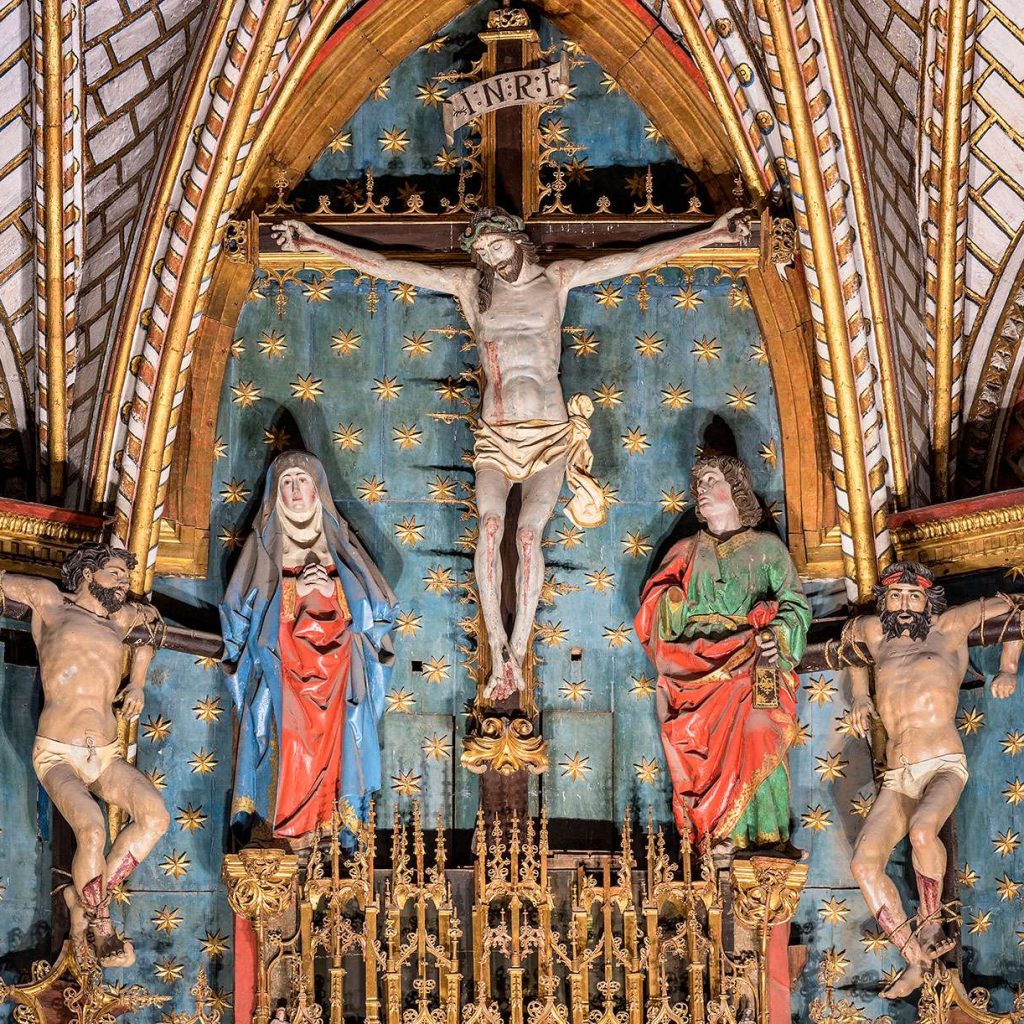
The liturgical celebration is austere and unfolds in three moments: the proclamation of the Passion according to Saint John, the veneration of the Cross, and Holy Communion. The bishop, prostrate on the ground and in silence, implores a God who dies crucified. The Cross is solemnly presented in the sanctuary; the faithful come forward in procession to venerate it. The gesture is simple, profound, and deeply moving: to kiss the wood that was an instrument of death and has become the tree of life; to kiss the feet of Christ Crucified who, here and now, dies for us.
At the end of the celebration of the Passion of the Lord, the Cathedral is enveloped in profound silence, in the darkness of death, in the absence of the Bridegroom of the Church, who has died on the Cross. Everything is laid bare, time seems to stand still, silence reigns; only on the altar, flanked by two flickering candles, stands the Cross with its Redeemer.
Holy Saturday
The Easter Vigil
It is the great Sabbath: the rest of God. Jesus lies in the tomb. The Church keeps watch at His burial. She waits; she remains in holy fasting.
Around 11:00 p.m. begins the most solemn celebration of the liturgical year.
Before the Puerta de las Palmas, the new fire is blessed. “God said, ‘Let there be light!’… and He separated the light from the darkness”; now a new creation begins. The Paschal Candle—marked with the cross, the Alpha and the Omega, and the current year—is lit and, like a pillar of fire, proceeds through the Cathedral, illuminating the People of God with the paschal light of the Resurrection. The darkness is gradually dispelled by the light that each of the faithful receives on their candle, sharing in the light of the Risen One. The acolytes of the Colegio de Nuestra Señora de los Infantes enter bearing the paschal lambs on their shoulders, in one of the most moving moments of the liturgy.
The Easter Proclamation announces the victory of Life over Death. The Liturgy of the Word traces the history of Salvation; the baptismal water is blessed, and the Church renews her baptismal promises, thus participating in the Death and Resurrection of the Lord. The Paschal Candle, a symbol of the Risen Christ, will remain lit until Pentecost. It is the sign that Jesus Christ lives, immortal and glorious, in the midst of His people.
The night is transformed into dawn, into the joy of the Resurrection.
Easter Sunday
At 12:00 p.m., the Pontifical Mass is celebrated, presided over by the Archbishop. The Cathedral, mother church of the Archdiocese, solemnly proclaims the Resurrection of the Lord, as does all Christendom: from Rome to Toledo, from north to south. The Easter message reaches every corner of the earth: Christ is risen! He is truly risen! Thus it is proclaimed on this day in the Holy Land, in traditional Greek: Χριστός ἀνέστη, ἀληθῶς ἀνέστη.
The altar is clothed in light, music resounds beneath the vaults, and the people celebrate the triumph of the Risen Christ. The final blessing, with plenary indulgence, expresses the fullness of the gift received.
Holy Week comes to its culmination, but the Easter season opens as a horizon of fifty days of joy.
In the Cathedral of Toledo, Holy Week is an inner journey that passes through stone, music, and ritual to lead into the heart of the Mystery. Every liturgical gesture, every procession, every silence participates in a single reality: the living re-presentation of Salvation.